Tuesday, September 28, 2021

The Cusco Curmudgeon

22 Sep 2002

(Yes, I'm getting behind. Can't keep up with youthful, healthy Garth!)

My plan had been to spend a couple of weeks in Cusco learning Spanish and taking in the archeological wonders of the surrounding Sacred Valley, then tackling the famed Inca Trail to Macchu Picchu. But reality was not obliging. My diary, oozing self-recrimination, reveals someone struggling to come to terms with the limitations - and failings - of time and body. Oh you have much to learn young man!

My experience with altitude in the Colca Canyon was a sign of things to come. It took me a good week to adapt to the 3400m of Cusco. Walking totally exhausted me, and ongoing gut problems didn't help. One night at dinner I had a sudden nose bleed, and the proprietors plied me with coca tea - the local treatment for soroche (actually, coca leaves were the solution to all health problems!). I eventually came good, but not before cancelling my booking for the Inca Trail and falling into a funk that I was wasting my precious time - the curse of being an optimiser in a chaotic world.

In any case, Cusco is an extraordinary city, literally built on Incan foundations. Many of the older buildings have a layer of Incan stonework at street level before becoming brick higher up. This is taken to an extreme at the Convent of Santo Domingo, which was built around the ruins of an Incan temple. It's hard to think of a more stark expression of colonialism.

Convent of Santo Domingo. The curved grey stonework is Incan.

View over Cusco

Salt pans at Salinas

The experimental terraces at Moray took my fancy. These terraced depressions create a wide range of microclimates that may have been used for trialling different soils and crops.


Experimental terraces at Moray

Sacred Valley
Ollantaytambo is an impressive contruction on a steep hillside. The main wall consists of six giant blocks that fit together perfectly, a remarkable feat of precision engineering at scale.


Ollantaytambo

Wednesday, September 15, 2021

In the Deep End

15 Sep 2002

Early on in my dreaming & scheming, I was intent on doing some trekking. The thing is, at that stage I had never actually done any overnight bushwalking! I did my first trip with Geoff to The Castle in the Budawangs only a few months before I left, by which time I had already invested in some of the camping gear. Foolhardy, naive, optimistic? Perhaps, but I was certainly right about it being my sort of thing!

So my second ever overnight walk was a solo trip, in a foreign country where I barely spoke the language, starting at high altitude and descending precipitously into what is claimed to be the deepest canyon in the world. But I was an invincible 21 year old - how hard could it be?!  It started at the Mirador Cruz del Condor, where Andean condors can reliably seen (along with a billion other gringos and touts). They are pretty ugly up close, but superbly graceful soaring on the thermals.

Andean condor

Mirador Cruz del Condor

Colca Canyon
 

The descent into the gorge was brutal, going from 3600m above sea level to 2200m in about a kilometre. I encountered a number of small aqueducts, carrying water from who knows where to fields unseen. The far side of the canyon was heavily terraced, but this side was a jumble of boulders and scrub, and I was lucky to see what I think was a mountain viscacha.

My route took me down the switchbacks, across the river up towards Tapay at the top right, then along to Malata & Cosnihua in the center, before dropping down to spend the night near the river at Sangalle

Mountain viscacha
 

At the bottom I crossed the river and found a nice spot to recuperate, looking back at the way I had come. There were two backpackers following behind and I idly watched them with my binoculars. From higher up I heard loud voices and a clatter of rocks - some local kids were running down the path, cutting corners so they were virtually coming straight down the cliff-face. I suspect they were on their daily communte from school! Suddenly they stopped and gathered together, considering something closely, then heaved a boulder off the path. My brain had long enough to realise that it was heading right for the backpackers below, but not long enough to actually do anything thing about it. All I could do is watch as it tumbled down, gathering pace. Thankfully the backpackers heard it coming and stopped in their tracks, letting it pass a few metres ahead. No damage was done, though they got quite a fright and had some pretty firm words for the kids when they caught up!


One lesson from the first day of walking was that I had to cut back on my pack weight. This was hammered home the next day when the walk out of the canyon took me eight hours instead of the expected three. Two of those were spent under an overhang avoiding the scorching sun, but also because I felt absolutely awful. I suspect I had altitude sickness, and possibly some underlying gastro. It would take me over a week to acclimatise to the elevation, and gastro would be a fickle companion for the next six weeks. I finally made it to town where I gratefully collapsed into bed, only to be awakened at dawn to the god-awful braying of a donkey right outside my window. 

From my email: "Ever noticed how donkeys sound like two humpback whales mating on a squeaky bed?"

Saturday, September 11, 2021

On the Gringo Trail

11 Sep 2002

Over the next few days I hit the road, following the Gringo Trail down the coast before heading inland towards the mountains. I found myself conflicted about being on the main backpacker route, doing touristy things. I fell in with some cute Israeli girls, but soon left them behind because I couldn't stand their excessive whinging and posturing: "We're not tourists, we're muchileros (backpackers)!" 

From my diary: "They would have their photo taken in front of a great view, somewhat reminiscent of hunters standing proudly over their kill. As if to show off to everybody what they'd done - as if the view wasn't worth a photo for its own sake. I got the feeling from the vibe on the tour that people were there because that's the done thing, not because they had a particular interest in it. Ah well, I suspect I'm guilty of the same offence."

In retrospect I wonder if I my lack of enthusiasm was also related to being so far out of my comfort zone - it's hard to open yourself up to wonder and awe when you feel unsafe and uncertain. It was still early days in my travels and I had a lot of confidence to gain.


The Peruvian coast south of Lima is desperately dry and barren, but the cold Humboldt current means the ocean is teeming with life.

Islas Ballestas


Lagunillas, Peninsula de Paracas

The original inhabitants took advantage of the landscape to construct huge images that are only visible from high above. One theory holds that shamans conceived of the idea while tripping on psychedelics, their awareness expanding to transcend beyond the earth-bound. I used modern technology instead and splurged on a flight to view the Nazca Lines from the air. The lines were cool, but I think I was more excited by my first flight in a small plane!

Monkey, Nazca Lines

Spider, Nazca Lines

The bus system in South America is awesome. You can get anywhere, in any level of (dis)comfort. Every town has a bus station where all the bus companies have a shopfront, with the timetable and prices clearly displayed. You can quickly do a circuit and work out who's going where, when, for how much and in what sort of bus (for the economist types, it seems very close to a 'perfect market').

Salespeople give a cut to the driver to stand at the front and spruik their wares. In the Andean countries a preponderance of these was dental-related - for good reason, as the state of people's teeth was atrocious, thanks to copious soft drink consumption and little dental care. For the locals these touts are probably quite tiresome, but they provided me with a welcome distraction. On the bus from Pisco to Ica some musicians obliged us with some folk tunes - authentic or not, they were very entertaining.

Musicians on the bus from Pisco to Ica

Despite talking up the bus service, I arrived in Arequipa at 2am with my first mild bout of gastro. Arequipa was beautiful, with possibly the finest Plaza de Armas I encountered on the whole trip. But I wasn't that keen to be spending time in towns - I wanted mountains, nature, wilderness! There was plenty of that to come, and a fair bit more gastro too...

Plaza de Armas, Arequipa

Tuesday, September 7, 2021

Jewish in Lima

From Easter Island I made my way to Lima (Peru), with an overnight stop in Santiago. Still painfully daunted by the language barrier, I couldn't muster the courage to go out for a proper dinner or breakfast and made do with snacks from the nearest corner shop.


In Lima I found myself staying in an Israeli haunt - I must have failed to read between the lines of my guidebook. On arrival I asked a question in English and was met with blank faces until they realised I was speaking neither Hebrew nor Spanish. Israeli backpackers tend to stick together, but I was befriended by a girl called Amira who included me in their adventures. From an email (I couldn't find the apostrophe key):

"Fell in with a bunch of Israelis, and as it happened, last Friday was the Jewish New Years, so off off I went to celebrate with them.  Only problem was that the hosts were iffy about letting a Jewish girl called Christian come to the show, so we doubted if theyd be happy about a Roman Catholic Aussie.  As a precaution, we conconcocted a new identity for myself:  I became Guy Feldman for the night, mother an Israeli Jew, father an Australian, and we emigrated to Australia when I was five - hence my complete lack of Hebrew.  Unfortunately, I didnt need to use my false identity, but Im sure the fact that I had someone translating into my ear constantly drew some notice.  The Israelis were all prettyndty disappointed my the event:  for a start they had to *pay*, which is unheard of for a religious celebration, and there wasnt a great deal of food, nor was it very tasty.  But it could just be that Israelis like to whinge.  I had a good time, theyve got some funky songs, and I got to wear a skull cap for a while, but it kept falling off ...  guess I wasnt mean to be a Jew."

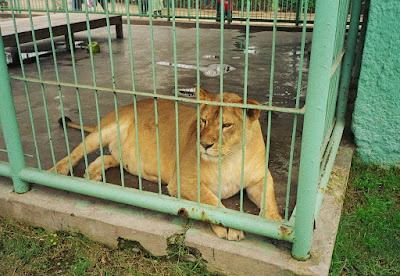
Perhaps I wasn't meant to be a Jew (or a Christian, it now seems!), but my haggling ability was nearing Israeli levels. I knew I needed to back off when Amira raved to her friends about the good deal I had extracted from a taxi driver. We had gone to the zoo together (this sounds like a date - it could have been a date - but I was too uncertain and she too reserved so nothing happened ... alas!) and while they had some cool animals, the conditions were pretty awful.

Parque de Las Leyendas

I was getting more comfortable with my limited Spanish and could just about manage the basics. My next challenge was coming to terms with the many con-people out to take advantage of the naive traveller. I had expected touts trying to sell me stuff, and pickpockets or bag-slashers, but many who approached me were much more subtle, with a blurring of commercial transactions and social relationship that confounded my simple brain (this came to a head in Cuba - stay tuned). I nearly lost US$100 in what I suspect was a counterfeiting scam, rather than a black market currency exchange. And a very friendly couple in the Plaza de Armas called me "Super Man" and wanted help with their English grammar - perhaps they were legit? Funnily enough, I did actually see a guy in full Super Man costume striding through the streets later on.

I had a pretty open itinerary from here on. My next flight wasn't until late December from the southern tip of Chile. Amira invited me to head north with her friends, but I didn't fancy being a hanger-on without Hebrew, so headed to the bus station happily on my own.


Ossuary in the catacombs under the Basílica y Convento de San Francisco

Wednesday, September 1, 2021

The Fall of the Moai

1 Sep 2002

There was an American woman, Sarah, staying in my hospedaje (hostel). I'm not sure if she took pity on my green-ness or just liked company, but we spent the next few days touring the island together, via foot and a little Suzuki 4WD.

On the first day we walked (a long) eight hours along the remote west coast from the town of Hanga Roa to the only surf beach on the island, Anakena. The terrain was spectacular, and typical of Easter Island: a blanket of verdant grass liberally scattered with black basalt boulders - not a tree to be seen except where planted by human. Along the way was a charming homestead nestled between escarpment and ocean, where we met a mainland Chileno who spent his summers there - quite the beach shack! He explained that the polypipes we had encountered were actually for pumping fresh water out of the sea. There is little in the way of surface water, so underwater springs are critical.

On the way to Anakena

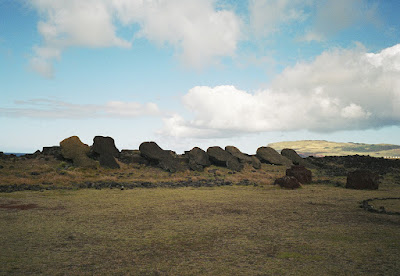
Anakena is where the first Polynesians would have arrived, and where Thor Heyerdahl completed his voyage on the Kontiki in an attempt to prove that the Easter Islanders came from South America (he was wrong). Easter Island is, of course, famous for its massive sculptures (moai) which stand on platforms (ahu) overlooking old village sites. They are said to be ancestors looking over and protecting their descendents. But when the first Europeans arrived, they had all been toppled.

Ahu Hanga Poukura

At Anakena there is a solitary standing moai, which Heyerdahl raised manually, to prove it could be done without modern technology. But to move and erect a statue uses huge amounts of timber. In Jared Diamond's book Collapse, he argues that the islanders got carried away in a frenzy of one-up-moai-ship, going so far as to cut down all the trees, which triggered an ecological collapse, soon followed by social collapse, and the moai were toppled in the resulting inter-tribal warfare. By the time Europeans arrived, only a few desperate islanders remained to scrape a poor living from the degraded landscape - easy pickings for slavers. Another hypothesis puts the blame on introduced rats, which ate the seeds and seedlings of the native trees so they couldn't regenerate. And yet another that there was no social collapse, and that it was all the European's fault.

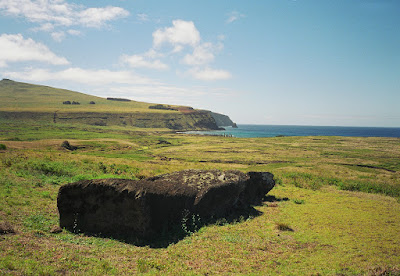
Whatever the case, the moai are truly incredible, and the vistas are uninterrupted. At the main quarry of Rano Ruraku there is the largest moai ever made, but which never made it to an ahu. It is 20m long! The largest erected was 10m.

The quarry at Rano Raraku
 
Buried moai at Rano Raraku

My visit to Easter Island was a great success, though the prospect of not having Sarah and her Spanish was slightly worrying ... I'll finish with this pithy observation from my diary:

"At Ahu Tongariki we saw a photographer and a girl scantily dressed. They were taking photos for postcards. Funny."

View towards Ahu Tongariki

Ahu Tongariki

View from Maungu Puakatiki

Sunset and storm from Maunga Terevaka, the highest point on the island at 506m

Sunday, August 29, 2021

First stop ... Easter Island!

29 Aug 2002

First stop, Easter Island! (aka Rapa Nui or Isla de Pascua) 

As the most isolated inhabited island in the world, it's not particularly easy to get to. I had a fancy round-the-world ticket which was only valid with a selection of airlines, so rather than take the direct route via Tahiti, I flew all the way to Santiago in Chile, then promptly jumped on a plane and flew a third of the way back across the Pacific Ocean. The upshot of this was that we were heading west at dusk, chasing the sun over the horizon for a glorious extended sunset.

View over Hanga Roa

On the first non-travelling day of my big adventure I walked from the main town of Hanga Roa to the ceremonial village of Orongo which is perched on the edge of one of the island's three volcanoes. One side slopes steeply down into a water-filled crater, and the other drops precipitously to the ocean. Apparently the original Polynesian inhabitants would slide (careen?) down the crater walls on banana leaves. There was also an annual competition to swim out to a group of offshore islands. The first to find a bird's egg and return would be honoured as Birdman and have his achievement immortalised in petroglyphs. This is a genuinely impressive feat, as they would have had to dive off huge cliffs into wild seas, then swim a kilometre there and back.

Ranu Kao

At Orongo I had my first experience of not being able to speak the local language. The ranger said something to me in rapid Chilean Spanish, and I was dumbstruck. I had no idea what she'd said, and with mouth agape, couldn't even begin to phrase a response. I'd spent a few months learning Spanish, at night college and with teach-yourself books and tapes, but I was desperately under-prepared for the real thing. I couldn't even bring myself to say "No hablo espanol". Luckily, another person there spied my predicament and had some English, so was able to help me out. I felt completely out of my depth, dumb, inadequate, even disabled - a salutary lesson (as my dad liked to say, repeatedly, "Training for life, son.")

Motu Kao Kao, Iti & Nui, viewed from Orongo. Petroglyphs in foreground.

Friday, August 27, 2021

Garth Goes to South America - 19 year anniversary edition!

On this day in 2002 I set off on a six month backpacking trip through South and Central America. I'm planning to post my photos and recollections from the trip, as close to the actual day/month as possible.

Here is me fresh-faced at 21 years old, raring to go and perhaps just a touch apprehensive. I am wearing exceedingly shiny nylon travel pants, and a white Tea Party shirt (alas from their underwhelming album Triptych - the start of their slide into mediocrity). I had spent months planning this trip, and yet I wore white! Luckily the hard-working laundresses of the Andes could get anything clean-as-new. The washing machines of the wealthier countries were no match. 

One might ask why I'm doing this, and why now. Certainly, next year would have been much more numerically pleasing. But right now, the idea of heading off on such an adventure is ludicrous, and the looming spectre of climate change makes it morally indefensible. In 2002 a big overseas trip was regarded as a rite of passage, in a world that, despite 9/11, hadn't started to unravel. A young person on the cusp of adulthood just doesn't have the same opportunities, nor the cause for optimism that we still carried back then. So there is an element of nostalgia for those glory days when we were footloose and fancy free. More personally, perhaps I'm at a stage where there is some value in facing up to who I was, and what I have lost from carrying the burden of ME/CFS.

Some background to my trip: My third year at uni in 2001 had been hard work, and I was ready for a break before tackling another two years. I hadn't taken a gap year after college - I was only 17 and there is no way I was mature enough to venture out into the actual world. Over summer I had a fantastic internship with CSIRO doing a cool project with Greg Castle on haptic virtual reality. They then sent me for a few months to Perth, where I got paid a real salary, so could save heaps of money and do lots of planning for my trip.

I was the only one of my brothers to go on an extended backpacking trip. But my Mum had been on a big round-the-world trip via Africa back in the late-60s, and her dad had a huge adventurous streak which he satisfied by dragging out his war service in the Melanesian islands and with his aboriginal tracker mate in the wilds of the NT. Perhaps it's a Boxall thing.

I settled on South America for a few reasons: Europe and North America weren't adventurous enough; South-East Asia was too stereotypical (I tried a bit too hard to differentiate myself ...); Africa seemed intimidating and didn't allow the kind of independent travel I was after; and the Middle East and Central Asia was a no-go so soon after 9/11. Also, I'd only have to learn one language for a whole continent (I didn't got to Brazil). But most of all, when I was a kid I read all the Willard Price books, starting with Amazon Adventure! 

This series followed Hal & Roger as they traipsed around the globe catching wild animals for their father's zoo on Long Island. Luckily I didn't absorb too much of the wealthy colonial white privilege, but I developed a huge love for nature and wilderness. I had to go to the Amazon.


So stay tuned to find out where I went and what I got up to!

---

For those who aren't on facebook regularly, I'll be posting to my blog at:
wildwoila.blogspot.com. 
 
The RSS feed is:
https://wildwoila.blogspot.com/feeds/posts/default
 
You can use that in www.feedrabbit.com to get emailed whenever I publish a post.

Books reviews for 2025

In 2025 I read 68 books, which is par for the course. Number of pages, however, was at a high of 23,142 (data since 2023), for which I thank...